
 Fredrick Dooley
Every business deals with financial ups and downs. This isn’t failure—it’s just how things work. The key difference between surviving and getting ahead is planning ahead. This planning isn’t being negative. It’s how you make your business tough enough to last.
Those slow periods come from all sorts of places. A bad economy, a new competitor, and customers changing their minds. For some, like shops or builders, it’s just part of the yearly cycle. For others, it hits out of nowhere. But the result is the same: if you aren’t ready, a simple slowdown becomes an emergency. You end up firing people, taking on bad debt, or cutting corners just to keep the lights on.
Good financial planning turns a big threat into something you can handle. It lets you make clear choices, keep your team together, and maintain quality. You might even find new opportunities when things are slow.
This article shows you how to do that. We’ll look at finding your business’s seasonal patterns, planning for different financial situations, and creating a cash buffer. Do this, and your business won’t just get through tough times—it’ll come out ahead.
Identifying Your Business Patterns
To plan for slow periods, start by looking at your own data. You need to move past a general feeling of “busy” or “quiet” and identify the actual patterns. Focus on three main areas: your seasonal trends, the wider economy, and cycles specific to your industry.
Seasonal Trends
Start by mapping your most obvious cycles. This means moving past gut feelings and looking at the data.
- Analyze historical data: Review at least 2-3 years of sales to find your consistent peaks and slumps.
- Look beyond revenue: Examine supporting metrics like customer traffic, website visits, and support ticket volume.
- Answer key questions: Is there a summer lull? A holiday surge? A predictable post-tax season slowdown?
- B2B consideration: Your cycle may depend on your clients’. If you serve the education sector, for example, your rhythm will follow the academic calendar.
Why this matters: Understanding this pattern allows for precise cash flow forecasting, smarter inventory scheduling, and accurate staffing plans.
Economic Factors
Economic factors externally influence your business in significant ways. Interest rate changes, inflation, employment rates, and consumer confidence indices can all impact spending behavior. A recession might mean your premium products see a decline, while essential services hold steady.
Monitor leading economic indicators relevant to your customer base. If you’re a luxury goods retailer, stock market trends might be a leading indicator. If you’re in essential home services, local employment data is more critical.
By linking your historical sales to past economic trends, you can better forecast the effects of future shifts.
Industry Cycles
These are the major, slow-moving trends in your sector: technological disruption, regulatory shifts, and competitor consolidation.
Critical questions:
- Technology: Is a new innovation making your current model obsolete?
- Regulation: Are there pending laws that will increase your costs?
- Events: Do annual conferences or product cycles create predictable surges in activity?
Action: Gain insight by participating in professional groups and monitoring industry news.
Look at the data from these three areas together. It will give you a complete picture of what affects your business. The point is to answer one important question: Is a slowdown just part of your normal seasonal cycle, or is it a sign of a bigger economic or competitive problem? Knowing the difference is what tells you how to respond.
Creating Financial Scenarios
The next step is to create formal financial scenarios based on your pattern analysis. Scenario planning isn’t about pinpointing the future. It’s about preparing for a few realistic versions of it. This method replaces the fear of the unknown with structured options you can manage.
The Three Core Scenarios
Businesses typically build three core scenarios for planning:
- The Realistic (Base) Scenario: This is your most probable financial forecast. It extends your current trends and past seasonal patterns into the future, assuming the economy remains stable. This becomes your working budget.
- The Best-Case Scenario: This model outlines what happens if several positive variables align—perhaps the economy strengthens, a new marketing campaign succeeds beyond expectations, or customer retention improves. It helps visualize potential upside and set ambitious yet informed strategic goals.
- The Worst-Case Scenario: This is your essential stress test. It asks the difficult “what if” questions: What if a key client leaves? What if sales drop by 25% for a quarter? What if a supply chain issue doubles your input costs? Constructing this scenario is not an exercise in pessimism; its sole purpose is to ensure operational survivability by identifying your absolute financial floor.
Building the Models
To build these scenarios, follow these steps:
- Baseline: Begin with your detailed, current monthly budget.
- Adjust: Change the key variables—revenue, COGS, and operating expenses—by meaningful amounts (e.g., +/- 20-25%) to match each scenario’s story.
- Project: Extend these adjusted figures over your critical planning horizon, which is typically 12 to 18 months.
Defining Your Financial Safety Net
This process ultimately answers the most critical question: How much cash buffer do you actually need? The answer is found in your worst-case scenario. Calculate your monthly “burn rate” (net cash outflow) under that severe stress test.
Your safety net, or “rainy day fund,” must cover a minimum of 3 to 6 months of your worst-case operating expenses. This money allows you to pay for essential costs—such as rent, employee salaries, and utilities—during a long slowdown. It prevents you from taking on expensive debt or making severe, reactive cuts to key parts of your business.
Ultimately, scenario planning serves two key purposes. It prepares you for different outcomes, and it defines the exact size of the financial safety net you need to build. That target is the final step in creating a resilient business.
Visualizing Different Financial Outcomes
Raw numbers in a spreadsheet can be paralyzing. They’re just data points without a clear story.
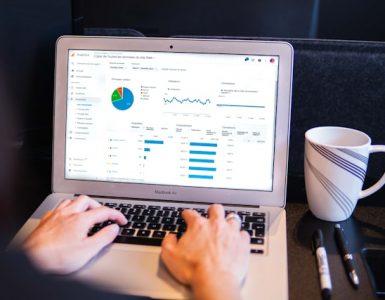
This is where visualization becomes critical. It converts complex financial projections into intuitive, actionable insights that everyone—from you to your team to potential investors—can understand in seconds. The primary tool for this is building a scenario planning dashboard.
Think of this dashboard as your business’s financial instrument panel. It’s a single view that displays the critical gauges for each of your possible futures, allowing you to monitor different paths at a glance.
What to Include in Your Dashboard
An effectively designed dashboard provides a side-by-side comparison of your three financial scenarios using the following essential metrics:
- Monthly Cash Flow: A visual view of your cash flow that shows when reserves may be used and by how much.
- Runway: A simple countdown timer (in months) showing how long your cash reserves would last under each scenario.
- Profit & Loss (P&L) Statement: A comparative view of projected revenue, expenses, and net income for each case.
- Key Driver Metrics: Charts showing the assumptions (e.g., customer count, average sale price) that differentiate your scenarios.
The Power of Comparison
This side-by-side visual format is transformative. It allows you to instantly comprehend the gap between your best and worst cases. More importantly, it helps you identify the specific “levers” that have the greatest impact on your financial health.
For example, you might visually see that a modest 10% improvement in customer retention pulls your realistic scenario’s cash flow sharply upward, instantly clarifying it as a top strategic priority.
How to Build It: Modern Tools
Fortunately, creating this is more accessible than ever. You don’t need to be a data scientist. The process typically starts by connecting your existing accounting software (like QuickBooks or Xero) to a business intelligence (BI) platform.
For instance, using a dedicated integration service like https://quickbooks-topowerbi.com/ can streamline this connection. A platform like Microsoft Power BI can then automatically pull live data from your books to populate and update your scenario models.
This means your dashboard isn’t a static snapshot; it becomes a dynamic management tool. You can see in real-time how your actual performance is tracking against each projected scenario, allowing for immediate and confident course corrections.
This change moves financial planning from an annual, rigid task to a continuous, active part of your strategy. It enables quick, data-driven decisions, so you’re not just preparing for the future but actively guiding your business toward it.
Building Your Safety Net

Visualizing scenarios highlights the need for a buffer; building your safety net is the action that provides it. This fund is your business’s financial airbag, designed to deploy during a collision with a slow season or unexpected crisis.
Start by funding your reserve gradually. Aim to automatically transfer a small, fixed percentage of monthly revenue into a separate, liquid business savings account. Treat this transfer as a non-negotiable operating expense. The 3-6 months of worst-case expenses from your scenario planning is your ultimate target, but even one month’s worth is a powerful start.
Beyond cash reserves, diversify your safety net with these strategies:
- Secure a Line of Credit: Apply for a business line of credit when your finances are healthy. Having access to this capital at a pre-negotiated rate is far better than scrambling for a loan under duress.
- Reduce Fixed Costs: Renegotiate leases, switch to scalable SaaS subscriptions, or outsource non-core functions to convert fixed costs into variable ones.
- Diversify Revenue Streams: Use slow seasons to develop offerings that are counter-cyclical to your main business. A landscaper might offer snow removal; a tax accountant might develop a year-round small business consulting service.
- Strengthen Relationships: Communicate openly with key suppliers and lenders about your proactive planning. They are more likely to offer flexibility if needed if they see you as a prepared and responsible partner.
Remember, the purpose of this net is not to sit idle forever. It is to be used strategically to withstand downturns without compromising the core health and mission of your business, allowing you to rebound quickly when conditions improve.
Conclusion
Running a business is naturally full of cycles. There will be busy times and slow times. If you ignore this reality, your business is exposed to unexpected changes. If you accept it, you can build real resilience. The act of planning for slow seasons and financial uncertainty is a fundamental responsibility. It is how you manage your business well for yourself, your employees, and your customers.
This process turns uncertainty into a plan. By understanding your patterns, building financial models, and saving money, you move from reacting to leading. When a downturn comes, you’re prepared. You’ll have clear data, a cash reserve, and a strategy ready to use.
This readiness offers a real advantage. It allows you to invest when others are retreating, hire talent when it’s available, and face the future with confidence.
Begin today. Look at your past years’ data, sketch out three scenarios for the year ahead, and open that separate savings account. The peace of mind and strength you gain will be the foundation for your business’s sustainable, long-term success.





Add comment